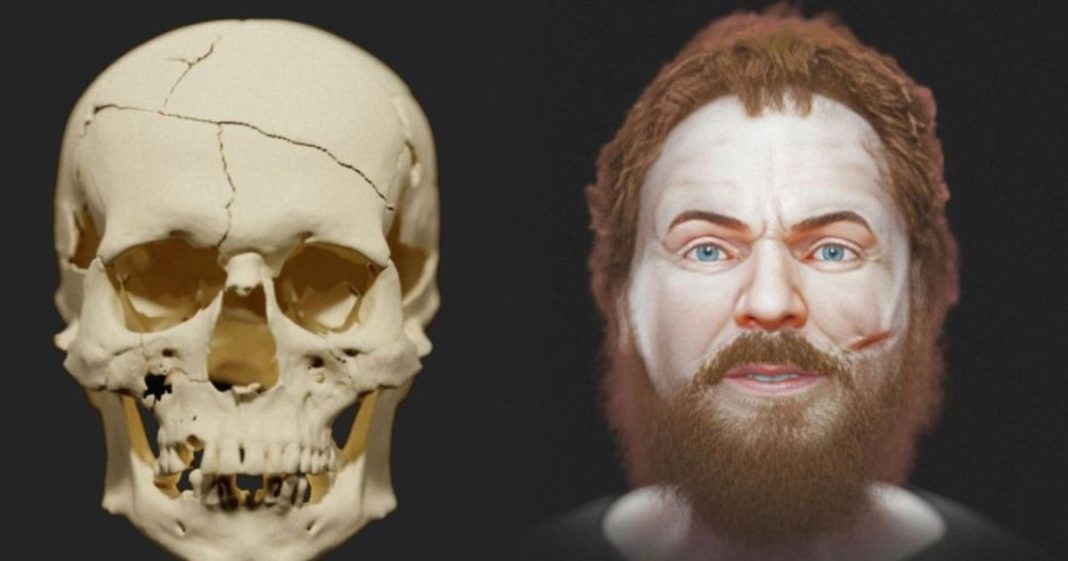

A Slavic man believed to be so violent people feared he would return from the dead as a real-life vampire has had his face reconstructed more than four centuries after his demise

(Image: Cicero Moraes)
Scientists have reconstructed the face of a Slavic man once believed to be a real-life vampire.
The 15th or 16th century corpse was uncovered at Racesa fortress in Zagreb, Croatia, and was one of more than 180 burials found at the site, which lies 70 miles southeast of the capital.
Boffins have stated due to the number and the severity of the man’s injuries it is possible he could have been a soldier during his life – or simply someone used to violent confrontations. Experts have said the extreme nature of the man’s burial cannot be explained by natural decay or environmental damage.
Researchers have theorised the man’s remains were deliberately desecrated to prevent him from rising from the dead. The way the man’s head was removed from his shoulders has garnered attention from experts as there are no cut marks on his neck, skull or shoulders.
This suggests the man’s head was literally torn off of his body instead of cleanly decapitated. Archaeologist Natasa Sarkic has explained the man’s remains may have been desecrated due to the fear he inspired while he was alive.
She said: “Bioarchaeological analysis showed that this man often participated in violent conflicts, and died a violent death.
“He experienced at least three episodes of serious interpersonal violence during his lifetime. One of those attacks left his face disfigured, which could cause fear and repulsion, leading to social exclusion. Before even recovering from the penultimate trauma, he sustained a final fatal attack.”
Dr Sarkic explained it was believed people who lived violent or marginal lives were often at risk of becoming vampires after death.
The expert said: “Individuals who died violently, behaved violently in life, or were considered sinful or socially deviant, were believed to be at risk of becoming vampires.
“He may have been regarded as a ‘vampire’, or a supernatural threat due to his facial disfigurement and his marginal lifestyle, characterised by repeated interpersonal violence.
“Such beings were thought to be restless, vengeful, and capable of harming the living, spreading disease and killing people or livestock.”
In Slavic folklore death isn’t considered the end as traditional beliefs state the soul remains attached to the body for around 40 days after dying. During this window it was feared the deceased could rise again from the grave. To bring the man’s face back to life, graphics expert Cicero Moraes used cutting-edge digital techniques. Experts began by virtually reconstructing his skull using CT scan data.
Dr Sarkic said: “Although the skull was somewhat fragmented at the time of its discovery, it was possible to reconstruct and digitise it.”
Researchers then compared the skull to data from living donors which helped them to calculate where various facial features would sit and how thick and soft tissues would appear across the face.
#Creepy #face #reallife #vampire #rebuilt #years #beheaded