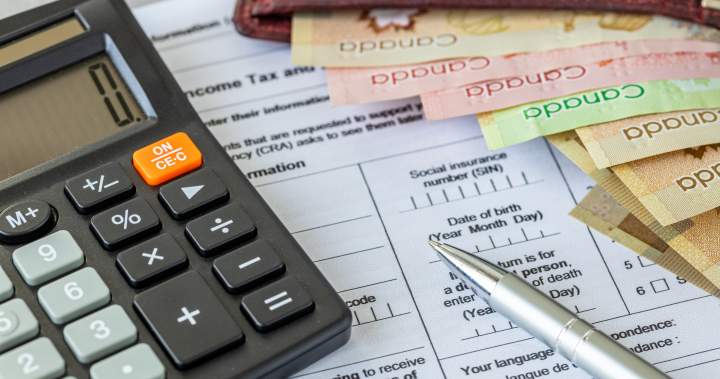

Canadians will be checking their bank accounts over the next few weeks hoping for a tax refund, but the spring bump is no longer just a bonus for many — it’s a financial lifeline, data shows.

Canada’s tax filing season is officially underway, with the tax filing deadline set at April 30.
An EQ Bank survey released last week shows more than one-third (36 per cent) of Canadians say they are relying on their tax refund more this year than last year, with the figure jumping to more than four in 10 (42 per cent) among younger Canadians aged 18-34.
Women (41 per cent) are more likely than men (32 per cent) to say they are relying on their refund for expenses.
“Canadians are using their refunds to reduce debt, build savings, and cover essential costs, with very little appetite for discretionary spending, like travel or dining,” said Dan Broten, senior vice-president and head of EQ Bank.

The data shows that younger Canadians are more sensitive to the cost of living crisis than the general population, Broten added.
“This is generally a life stage where many are taking on new financial obligations — from housing costs to daycare expenses — often without the same financial cushion as older cohorts,” he said.
“To us, it shows just how much every dollar matters right now,” Borten said.
Younger Canadians are facing an uphill battle when it comes to building wealth, said Justin Leon, financial adviser at Wealthsimple.
“When a once-a-year tax refund becomes the moment you finally catch your breath, that’s a signal that the gap between income and expenses has become structural, not temporary,” Leon said.
Get weekly money news
Get expert insights, Q&A on markets, housing, inflation, and personal finance information delivered to you every Saturday.
Around 28 per cent of respondents said they used their tax refunds to pay down their debt, with 22 per cent saying they used it to cover weekly expenses. Another 28 per cent said they contributed to a registered savings plan, like an RRSP or a TFSA.
Only nine per cent said they plan to use their tax refund on non-essential purchases such as travel, dining out or entertainment.
“A lot Canadians rely on that tax refund as a way to kind of buoy up their finances and just get a bit more breathing room. The problem is it doesn’t last,” said Stacy Yanchuk Oleksy, CEO of not-for-profit credit counselling agency Money Mentors.

How should you manage your refund?
It’s helpful to think ahead of time how you’re going to spend your tax refund, some financial advisors say.
“There’s no single formula that works for everyone, but a good starting framework is to think in thirds,” Leon said.
He recommends splitting your tax refund into three piles — one for paying down high interest debt, like credit cards, another for an emergency fund, and a third for a longer-term goal like putting it in a TFSA or RRSP.
“The order matters, though — high-interest debt almost always wins first, because the interest you’re paying is likely higher than any return you’d earn investing,” he added.
Oleksy recommends something called the “40-40-20” rule.
“Let’s say your refund is $1,000. We take 40 per cent, so $400, and we put it automatically into savings. You’ve got to pay yourself first. Take another 40 per cent, another $400, and put it onto debt and give yourself a bit of breathing room,” she said.
“And then, because we still have to live, take that last 20 per cent, or $200, and go have fun,” she added.

Is it enough to build wealth?
It may seem like a few hundred dollars from your tax fund may not go very far when it comes to building financial stability, but it goes “further than most people think,” Leon said.
“The earlier you start, the more compounding does the heavy lifting for you,” he said.
Financial advisers can often give you advice on how you can invest the money in your TFSA or RRSP, compounding it over time instead of just letting it sit idle.
“To put it concretely, $500 invested today in a diversified portfolio at a modest average return, left alone for 30 years, could grow substantially — without you ever adding another cent. Add regular contributions on top of that, and the picture changes dramatically,” he said.
He also recommends setting up automatic payments, even if it’s one as small as $25 a month.
“When investing happens automatically, you stop seeing it as a decision and it just becomes part of your financial rhythm,” he said.
© 2026 Global News, a division of Corus Entertainment Inc.
#tax #refund #feels #lifeline #youre #National