
As climate change tears their Arctic world apart, giant walruses are battling to survive. Every day, calves are losing their parents, getting crushed in stampedes and stranded on shrinking ice floes.
But a moving new documentary, following the rescue of one abandoned calf named Uki, reveals there is still hope for one of the planet’s most extraordinary animals. Here, Julia Kuttner speaks to filmmaker Kirk Johnson…
While most wildlife shows don’t intervene, this is a programme made with a difference.
Palaeontologist Kirk Johnson has spent 40 years fascinated by walruses, ever since seeing a giant herd for the first time in Alaska. Now he has travelled deep into the Arctic for Walrus: Life on Thin Ice, to uncover how the huge, tusked mammals are battling a rapidly warming world.
Walruses can weigh more than 1.5 tonnes and gather in huge herds across the icy waters of the Bering Sea, between Alaska and Russia.
But as sea ice disappears, more and more of them are being forced onto beaches where overcrowding can quickly become deadly.
Huge, panicked groups can crush one another during stampedes, while vulnerable calves are becoming separated from exhausted mothers.
Kirk says: “We’ve lost something like a million square miles of summer sea ice since the late 1970s, so it’s a profound decrease.
“It’s really impacting the productivity of the sea floor in the Bering Sea so there’s less food for walruses and whales.
“It’s causing the walruses to haul out onto beaches rather than onto ice floes.”
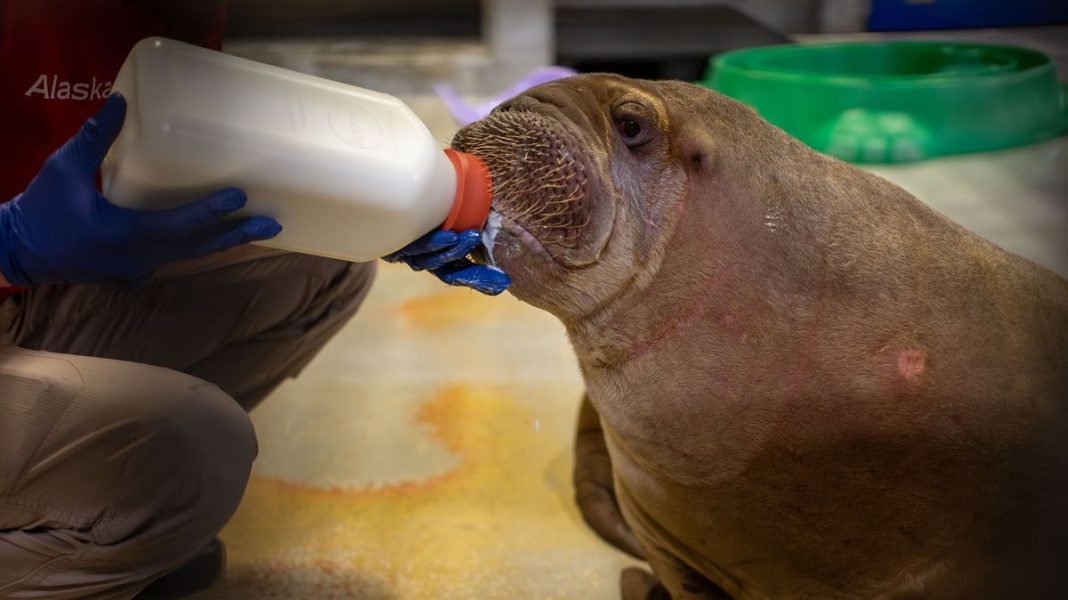
At the heart of the documentary is the rescue of orphaned walrus calf Uki, who was discovered alone and hungry on the Bering Sea coast in Alaska in 2024.
The tiny calf was retrieved by experts from the Alaska SeaLife Center, in Seward, Alaska, who admitted her into their wildlife response programme and provided life-saving rehabilitation care for more than two months.
Kirk says the rescue was a rare stroke of luck because baby walruses rarely survive alone in the wild.
“Baby walruses just can’t survive by themselves,” he explains. “When they wash ashore, there has to be someone there to find them and get them to a place that can take care of them. They can’t go back into the wild.
“They’re so dependent on their mum and their mum’s milk and babies stay with their mothers for two years. When one gets separated it’s pretty much curtains for those little guys.”
The film follows Uki’s recovery, going from a badly injured calf to a thriving young walrus living at SeaWorld Orlando in Florida. She has bonded with an older female walrus, called Kaboodle, who is now like a surrogate mother.
Kirk says: “When we first filmed her she weighed about 80 pounds and she was all beat up. By the second time we saw her in Orlando she was already 300 pounds and now she weighs around 600 pounds.
“She’s doing just fine and when she’s fully grown, she’ll probably reach 1,200 or 1,500 pounds.”
The documentary also looks at the remarkable way walruses feed beneath the icy Arctic waters, devouring up to 5,000 clams each a day.
Kirk says: “They’re suction feeders. They suck the meat from the clam on the sea floor. They can spray water out of their mouth with great force and they can also suck with great force.
“They use jet water to excavate the clams, grab them in their lips and suck the meat out of the shells like spitting out a pistachio shell.”
The animals also rely heavily on their famous whiskers to survive. Kirk says they are like having “having hundreds of fingers on your face,” adding: “Every whisker goes back to a nerve root in the muzzle of the walrus.”
Walruses are also surprisingly affectionate, using their whiskers to feel each other’s faces as a greeting. “It’s a very beautiful thing to see when two big two-tonne animals put their faces together,” Kirk adds.
And despite the film’s bleak warnings over climate change, it ends on a hopeful note. Fossil discoveries along the west coast of America suggest walruses have already survived huge climate swings over millions of years.
“Animals do adapt to climate change and some animals are more adaptable than others,” says Kirk.
“If you’re a polar bear and there’s no sea ice it’s curtains. But if you’re a walrus you do love your ice, but you can function outside the ice as well.”
- “Walrus: Life on Thin Ice” premieres Friday May 29 at 8.10pm on PBS America.
#Orphaned #walrus #calf #rescued #film #crew #left #dead #block #ice