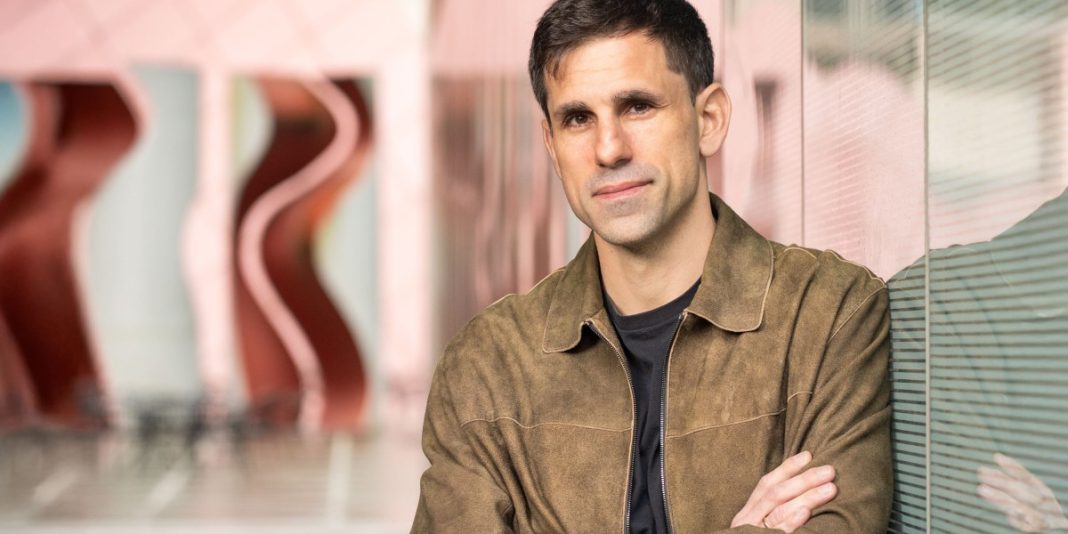

But de la Fuente is using artificial intelligence to bring about a different future. His team at the University of Pennsylvania is training AI tools to search genomes far and deep for peptides with antibiotic properties. His vision is to assemble those peptides—molecules made of up to 50 amino acids linked together—into various configurations, including some never seen in nature. The results, he hopes, could defend the body against microbes that withstand traditional treatments.
His quest has unearthed promising candidates in unexpected places. In August 2025 his team, which includes 16 scientists in Penn’s Machine Biology Group, described peptides hiding in the genetic code of ancient single-celled organisms called archaea. Before that, they’d excavated a list of candidates from the venom of snakes, wasps, and spiders. And in an ongoing project de la Fuente calls “molecular de-extinction,” he and his collaborators have been scanning published genetic sequences of extinct species for potentially functional molecules. Those species include hominids like Neanderthals and Denisovans and charismatic megafauna like woolly mammoths, as well as ancient zebras and penguins. In the history of life on Earth, de la Fuente reasons, maybe some organism evolved an antimicrobial defense that could be helpful today. Those long-gone codes have given rise to resurrected compounds with names like mammuthusin-2 (from woolly mammoth DNA), mylodonin-2 (from the giant sloth), and hydrodamin-1 (from the ancient sea cow). Over the last few years, this molecular binge has enabled de la Fuente to amass a library of more than a million genetic recipes.
At 40 years old, de la Fuente has also collected a trophy case of awards from the American Society for Microbiology, the American Chemical Society, and other organizations. (In 2019, this magazine named him one of “35 Innovators Under 35” for bringing computational approaches to antibiotic discovery.) He’s widely recognized as a leader in the effort to harness AI for real-world problems. “He’s really helped pioneer that space,” says Collins, who is at MIT. (The two have not collaborated in the laboratory, but Collins has long been at the forefront of using AI for drug discovery, including the search for antibiotics. In 2020, Collins’s team used an AI model to predict a broad-spectrum antibiotic, halicin, that is now in preclinical development.)
The world of antibiotic development needs as much creativity and innovation as researchers can muster, says Collins. And de la Fuente’s work on peptides has pushed the field forward: “César is marvelously talented, very innovative.”
A messy, noisy endeavor
De la Fuente describes antimicrobial resistance as an “almost impossible” problem, but he sees plenty of room for exploration in the word almost. “I like challenges,” he says, “and I think this is the ultimate challenge.”
The use, overuse, and misuse of antibiotics, he says, drives antimicrobial resistance. And the problem is growing unchecked because conventional ways to find, make, and test the drugs are prohibitively expensive and often lead to dead ends. “A lot of the companies that have attempted to do antibiotic development in the past have ended up folding because there’s no good return on investment at the end of the day,” he says.
Antibiotic discovery has always been a messy, noisy endeavor, driven by serendipity and fraught with uncertainty and misdirection. For decades, researchers have largely relied on brute-force mechanical methods. “Scientists dig into soil, they dig into water,” says de la Fuente. “And then from that complex organic matter they try to extract antimicrobial molecules.”
But molecules can be extraordinarily complex. Researchers have estimated the number of possible organic combinations that could be synthesized at somewhere around 1060. For reference, Earth contains an estimated 1018 grains of sand. “Drug discovery in any domain is a statistics game,” says Jonathan Stokes, a chemical biologist at McMaster University in Canada, who has been using generative AI to design potential new antibiotics that can be synthesized in a lab, and who worked with Collins on halicin. “You need enough shots on goal to happen to get one.”
#scientist #hunt #antibiotics